

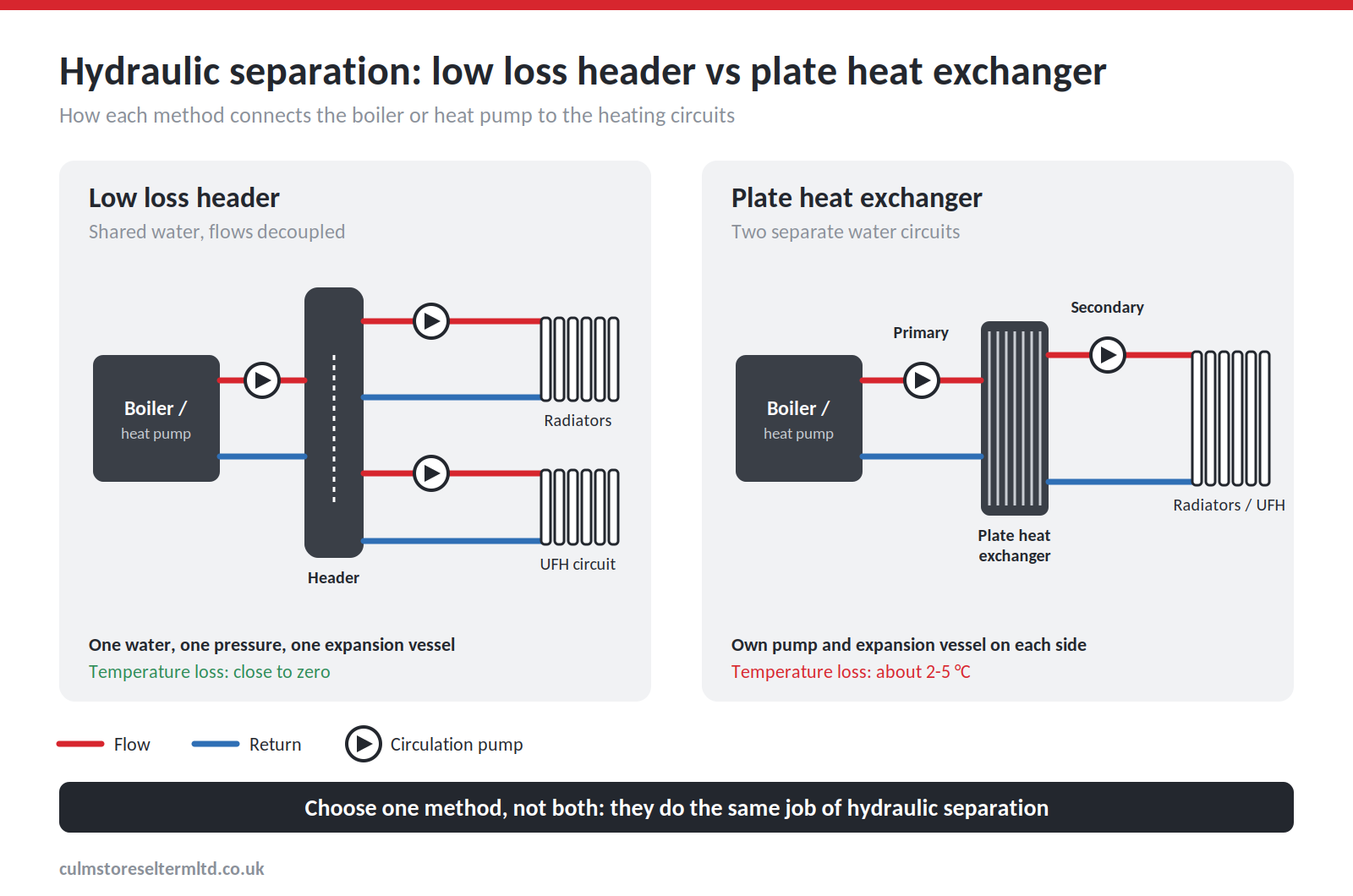
Hydraulic separation lets the boiler or heat pump circuit and the heating circuits run at their own flow rates, without their pumps fighting each other. In UK heating systems it is achieved in two main ways: a low loss header, where the water mixes but the flows are decoupled, or a plate heat exchanger, where the two circuits are hydraulically separated and never share water. Choosing the right one depends on the boiler or heat pump, the condition of the existing system and how many circuits it serves.
This guide is for heating engineers, installers and homeowners planning a new boiler, an electric boiler or a heat pump installation. It explains how each method works, compares them side by side and shows which suits each type of system. In most systems you choose one method, not both.
What Is Hydraulic Separation?
Hydraulic separation is a way of splitting a heating system into a primary circuit and one or more secondary circuits so that each one can operate independently. The primary circuit serves the boiler or heat pump directly. The secondary circuit distributes heated water to the radiators, underfloor heating and hot water cylinder.
Without separation, every circulation pump in the system acts on the same water, so individual circuits cannot flow independently. When several pumps run in series, they push against each other, flow becomes turbulent and unpredictable, and the boiler sees flow rates it was not designed for. Typical symptoms are uneven heating between rooms, noisy pipework and boiler short cycling.
Hydraulic separation creates a point of almost zero pressure difference between the primary and secondary circuits. The boiler pump only has to move water through the boiler circuit, and each zone pump only has to move water through its own heating circuit, so every hydraulic circuit keeps its own flow rate. Pumps can then operate as needed, which improves efficiency and overall performance, and makes it easy to add multiple heating zones later, each managed by the control system.
How Does a Hydraulic Separator Work?
A hydraulic separator, called a low loss header in the UK, is a short vertical chamber much wider than the pipework connected to it. The primary flow and return connect to one side and the secondary flow and return to the other. Because the chamber is wide, the flow velocity inside drops sharply, which creates a low resistance connection between the primary and secondary circuits.
At such low velocity, the primary pumps and secondary pumps no longer influence each other. If the primary flow is slightly higher than the secondary flow, the extra hot water passes down through the header and returns to the boiler side, so the heating circuits receive water at the full flow temperature. If the secondary flow is higher, cooler return water is drawn up and mixed in, lowering the temperature delivered to the radiators. Correct sizing and balanced flow rates therefore matter as much as the header itself. A condensing boiler also needs cool return water for high efficiency, which a well-balanced header preserves.
The slow water movement has a second benefit: debris and air separate out. Many low loss headers have an automatic air vent at the top and a drain valve at the bottom, often with a magnet, so they work as dirt separators too. Low loss headers are made in vertical and horizontal designs, and some include manifolds for several distribution circuits.
Hydraulic Separation with a Plate Heat Exchanger
A plate heat exchanger achieves hydraulic separation in a different way. Hot primary water flows through every other channel between thin stainless steel plates, while secondary water flows through the channels in between, usually in the opposite direction. Heat passes through the steel, but the two fluids never mix. The circuits are hydraulically separated and physically isolated: they can operate at different pressures, different temperature profiles and even with different fluids.
Most heat exchangers used in domestic and light commercial heating are brazed plate heat exchangers, compact sealed units that handle high pressure. Gasketed models, which can be opened for cleaning, are used mainly in large plant rooms.
Because the circuits share no system water, each side needs its own circulation pump, expansion vessel and safety valve. The primary circuit can hold a small, clean volume of treated water, so less treatment chemical is needed there, while the secondary circuit can stay as it is.
What Are the Disadvantages of a Plate Heat Exchanger?
The main disadvantage is the temperature drop between the two sides. A well-sized plate heat exchanger loses around 2-5 °C, so the boiler or heat pump must run hotter to deliver the same flow temperature to the secondary circuit. Other drawbacks include:
- higher cost, with an extra pump, expansion vessel and controls for the second circuit,
- pressure loss through narrow channels, which the pumps must overcome,
- sensitivity to sludge, scale and debris, so filters are needed on both sides,
- brazed units cannot be opened, so cleaning means chemical flushing.
Plate Heat Exchanger vs Low Loss Header
Use a plate heat exchanger when the two circuits must be physically separated, and a low loss header when they can share the same clean system water but need pumps that operate independently.
| Feature | Plate heat exchanger | Low loss header |
|---|---|---|
| System water | Fully separated, no mixing | Shared, mixing inside the header |
| Different fluids, such as glycol and water | Yes | No |
| Different pressures | Yes | No, one system pressure |
| Temperature drop | About 2-5 °C | Close to zero when flow rates are balanced |
| Pumps | One on the primary side, one or more on the secondary side | One on the primary side, one per secondary circuit |
| Expansion vessel | One on each side | One for the whole system |
| Air and dirt separation | No, needs separate filters | Often built in |
| Cost | Higher | Lower and more cost effective |
The low loss header suits most clean, sealed heating systems. The plate heat exchanger earns its extra cost and temperature penalty only where full system separation is genuinely needed.
When Should You Use a Low Loss Header?
Use a low loss header, or hydraulic separator, for hydraulic separation when one boiler or heat pump feeds multiple circuits with their own pumps and all circuits can share the same system water and pipework. Check the existing system layout first, so the boiler and zone pumps operate without disturbing each other. Typical cases are:
- a boiler serving radiators, underfloor heating and a hot water cylinder, each with its own circulation pump,
- two or more boilers working in a cascade,
- boilers with a powerful internal pump whose minimum flow requirement does not match the secondary flow rates,
- systems where different flow rates are needed in different zones as heat demand changes, controlled by zone valves or individual zone pumps.
Do I Need a Low Loss Header with Underfloor Heating?
Not always. If underfloor heating is the only circuit and the boiler pump can supply its required flow, a direct connection through a mixing valve is enough. A low loss header becomes worthwhile when underfloor heating runs alongside radiators or a cylinder in the same heating system, because each heating circuit then needs its own pump and its own flow rate. Our guide on how underfloor heating works with boiler systems explains the mixing valve and manifold in more detail.
Choosing Hydraulic Separation for Your Heat Source
The heat source and the state of the existing heating system decide which method fits best.
Gas Boiler, Oil Boiler and Electric Boiler Systems
With a gas boiler, oil boiler or electric boiler on a clean, sealed system with several zones, a low loss header is usually the right choice. It protects new boilers from flow problems, helps prevent short cycling and collects debris.
A plate heat exchanger is the better choice when the boiler must be protected from the rest of the system:
- an old system full of sludge and magnetite, where new boilers would be damaged by dirty water,
- an open vented system with a feed and expansion tank in the loft, which a sealed boiler cannot share,
- older underfloor heating pipework without an oxygen barrier, which causes corrosion,
- tall buildings where the static pressure exceeds the boiler's rating,
- combining a solid fuel stove and a boiler with different water quality.
Electric boilers have small water content and sensitive heating elements, so keeping them on a short, clean primary circuit behind a plate heat exchanger gives them the separation they need when the existing system and its pipework are in poor condition.
Do Heat Pumps Need Hydraulic Separation?
Not every heat pump installation needs it. A heat pump must always operate with at least its minimum flow rate, so if zone valves can close and stop the flow, separation through a low loss header or buffer vessel keeps the heat pump in stable, efficient operation. Simple systems with open emitters and enough system volume often work best connected directly, because every mixing point lowers the flow temperature.
A plate heat exchanger is used with a heat pump mainly when the outdoor circuit of an air source heat pump runs on glycol for frost protection, or when the heat pump must be protected from an old system. Because the secondary side runs a few degrees cooler, the heat pump must produce a higher flow temperature, and each extra degree lowers its efficiency by roughly 2-3%. A plate heat exchanger for a heat pump should therefore be sized for a small temperature drop.
Buffer Tank, Low Loss Header or Plate Heat Exchanger?
A buffer tank, or four-port buffer vessel, provides hydraulic separation like a low loss header but also adds system volume and thermal mass. That helps a heat pump avoid short cycling in mild weather, when the building's heat loss is small and heat demand drops, and gives time for defrost cycles. A low loss header separates flows with little added volume. A plate heat exchanger separates the water itself.
In short: choose a buffer tank when the system needs extra volume, a low loss header when it needs separate pumps on shared clean water, and a plate heat exchanger when the circuits must not share water at all.
Can You Use a Plate Heat Exchanger and a Low Loss Header in the Same System?
It is not recommended. Both devices provide hydraulic separation, so fitting both duplicates the job. A low loss header behind a plate heat exchanger adds another mixing point, more pumps, extra cost and a further drop in flow temperature, and makes operation and return temperature control harder to balance. If the secondary side of a plate heat exchanger serves several circuits, a distribution manifold with pump groups does the job without a second separation point. In a large or unusual system design where both seem necessary, the whole system and installation should be checked by a heating engineer.
Low Loss Headers and Plate Heat Exchangers from Culm Stores
Culm Stores supplies both methods of hydraulic separation. Elterm low loss headers are available from 40 kW to 156 kW, including sets with insulated 2-way and 3-way manifolds. Nordic Tec brazed plate heat exchangers cover 25 kW to 230 kW and come with insulation.
To complete the installation, browse pump groups, buffer cylinders, magnetic filters and electric central heating boilers, or contact Culm Stores with your boiler or heat pump type, output and design temperatures for help choosing.